

Ask any home visitor or parenting educator what the hardest part of their job is, and “goal setting” comes up more often than you’d expect. Not because it isn’t important — it’s a lot like planting a seed, simple but powerful, with outcomes that can grow far beyond that first conversation — but because it’s genuinely hard to do well.
Families in crisis mode often can’t think about the future — they can hardly think about the present moment. At every turn in the road, they’re realizing just how far behind they are. Ask a parent who’s juggling three jobs, childcare, and a stack of bills what their dreams are for their family, and you’re likely to get silence, a shrug, or a quiet “I don’t know.” That’s not resistance. That’s exhaustion. And it’s exactly the moment a good tool – and a little training – can make all the difference.
Why Goal Setting Breaks Down
Home visitors and family advocates around the country describe the same handful of roadblocks:
- Families can barely see past today, let alone dream about tomorrow.
- Embarrassment or shame creeps in the moment “goals” come up, and the conversation shuts down.
- Parents feel lectured or judged, even when that’s the last thing anyone intended.
- Big goals feel too big and overwhelming — and nobody’s handed them a way to break them into steps that feel doable.
None of this means families don’t want more for themselves and their children. It means they need a map, a vehicle, and a few driving lessons to show them how to get out of their current situation and into a brighter future.
One Tool for These Conversations: Reachables®
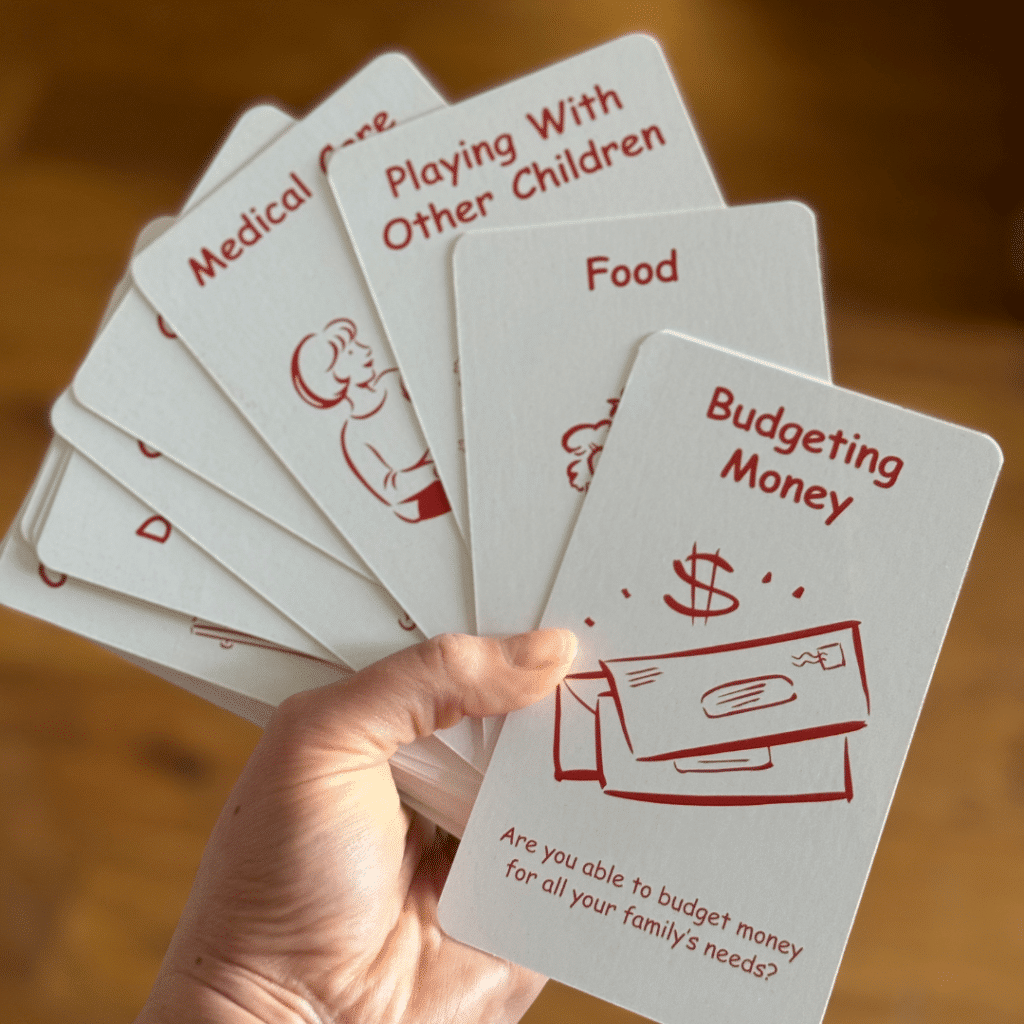
One tool designed for this kind of conversation is Reachables® Family Goal Setting Cards, developed by Healthy Families staff at Parenting Now from their own years of home visiting practice. Instead of a form, the cards give families something to hold, sort, and talk about.
Think of the cards as the map. Helping families to see where they want to go by exploring what they value, how they want to parent, and what they want their everyday life to look like. From there, small, reachable goals become the vehicle, moving a family forward one manageable step at a time.
A card-based approach works with a simple fact about people: it’s usually easier to react to something in front of you than to come up with an answer from scratch. Asking a tired or stressed parent to name their goals out loud can leave them staring at a blank page, unsure what the practitioner is hoping to hear. Choosing from a set of cards is a lower-stakes way to begin, and it keeps the family’s own choices at the center of the conversation.
The cards come in three decks, each covering a different part of that conversation:
- 🌟 Values & Dreams — what matters most, and what families want for their future
- 👨👩👧 Parenting — the kind of parents caregivers hope to be
- 🏡 Family Life — what everyday life could look and feel like together
They’re available in English and Spanish, and they align with Head Start Performance Standards (1302.35) for education in home-based programs.
Home Visitors Know Goal Setting Is Working When…
It’s easy to judge goal setting by what ends up on paper: a completed plan or a list of next steps. But in the early stages, the clearest signs often show up in how the conversation feels.
Everyone is in the conversation. Goal setting can easily turn into one parent answering while the other stays quiet. One home visitor described a very different scene: “Sometimes I had to step back and watch both parents engage in positive discussion with a great outcome.”
Families take their time. Another home visitor described a new family, a father from New Zealand and a mother from Sweden, who “both took their time studying the cards and discussing their picks.” When parents slow down and weigh their options, it suggests they’re treating the conversation as their own rather than something to get through.
Goals come from what the family values. A goal rooted in something a parent genuinely cares about is easier to keep working toward than one that’s handed to them. Listen for parents explaining why a choice matters to them, not just what they picked.
The parent starts building the plan. In one session, a parent who wanted to complete job applications named what was getting in the way: “I feel like I have the support system. I just haven’t really come up with a plan to make it happen.” With a few questions from the home visitor about time, steps, and available support, the parent began shaping the plan: “I think I would like to get five applications a week… Maybe we can do a three-hour block on Saturday, and then one- or one-and-a-half-hour blocks during the week.” — Parent
There’s a shared sense of direction. Participants have described watching both parents lean in, debate their choices, and leave the session on the same page about where their family is headed.
None of these signs show up on a form, which is part of why they’re easy to miss. Knowing what to look for helps home visitors recognize progress early and build on it.
How the Home Visitor’s Role Shifts
When goal setting is a form to complete, the home visitor ends up in the role of interviewer: asking questions, recording answers, and hoping the family opens up. That’s a tough position to be in, especially when a parent is quiet, guarded, or worried about being judged. Putting the family’s own choices at the center changes the role in a few ways.
- From interviewer to listener. When the cards open the conversation, the home visitor doesn’t have to carry it alone. As one educator put it: “It definitely opens up conversations.”
- From one voice to two. In two-parent households, a form often gets answered by whoever speaks first. Sorting cards invites both parents in, and home visitors describe stepping back while the parents talk it through with each other.
- From improvising to intentional. Having a clear process helps practitioners plan how a session will unfold rather than hoping it goes well. One home visitor said, “I like the idea to use it with intentionality.” Another described how that looks before a visit: “I like to pull out different ones that I think relate to the family: areas where they have strengths built up, and other areas that I think need more work.” — Home Visitor
The shift is small but meaningful. When the family is doing the choosing, the home visitor is free to do what they do best: listen, notice strengths, and guide.

Five Ideas You Can Use in Your Next Goal-Setting Conversation
Whether or not you ever pick up a deck of cards, a few principles make goal setting land better with families. Here are five worth trying.
- Build trust before you ever say the word “goals.” For a parent who’s been judged, graded, or lectured by other systems, a goal-setting conversation can feel like one more evaluation. Rapport comes first. Families need to feel safe before they can feel hopeful, and that safety is built in the small, ordinary moments of the visit, long before anything gets written down.
- Start with dreams, not tasks. Goals that matter to the program don’t always matter to the parent. Asking “What do you want for your family?” gets you somewhere very different than “What are you going to work on?” When a goal is rooted in something a parent actually values, such as being a calm parent, a stable home, or a child who feels loved, it has the pull to survive a hard week.
- Swap evaluative language for collaborative language. Small word choices change how a question lands:
- Instead of “You need to get a routine going,” try “What would a good morning look like for your family?”
- Instead of “Why haven’t you done that yet?” try “What’s getting in the way, and how can we work around it together?”
The first versions put a parent on trial. The second versions put them in the driver’s seat.
- Make the goal smaller than feels necessary. Research on scarcity, including the Science study linked below, found that financial worries can use up mental capacity that would otherwise go toward other tasks. One practical takeaway for practitioners: a parent who is already stretched thin may have little room left to hold a big, complicated plan. Smaller, simpler steps ask less of them. And when a barrier shows up, such as no transportation, an unreliable phone, or a lost job, it can often become its own mini-goal rather than a reason to stop.
One home visitor described how this played out with a new mom who was dealing with postpartum depression and struggling to keep up with her own basic self-care. Rather than building a big goal that would have felt out of reach, they made a simple checklist of daily tasks: take a shower, brush my teeth, comb my hair, wash my face. She worked through it every day. Two years later, she was ready to take on things like getting a job and finding childcare. As the home visitor put it: “I know what we did may seem like a very easy process, but I just wanted to note that it took two years to get to where we are today.” — Home Visitor
- Notice and name the small wins. A completed phone call, a kept appointment, or a first conversation about the future all count. Celebrating them builds confidence and keeps families engaged, and simple tools like a visual tracker or a checklist can make progress easy to see. For many parents, seeing proof that they can follow through is the first step toward believing they can.
One home visitor described pulling out the parent quality cards for a mom who felt she wasn’t a good parent, and asking what qualities she already had. “I didn’t think she was going to pick out anything, because she always put herself down. And then she picked out about six or seven of them, and we just clapped over that.” — Home Visitor
None of this requires special materials. It does take intention, which is why a structured tool can help.
Want to Go Deeper?
If you’d like to try this approach with the families you serve, you can learn more about Reachables® Family Goal Setting Cards, available in English and Spanish.
For practitioners who want support putting these ideas into practice, our on-demand training, From Overwhelmed to Empowered, walks through each step, so home visitors and parenting educators can feel confident guiding parents toward the future they want. The training is recommended but not required to use the cards.
Learn More
Curious about the research behind this work? These resources are a good place to start:
- Poverty Impedes Cognitive Function (Science, 2013). A study finding that financial worries can reduce mental capacity for other tasks, which helps explain why planning for the future can feel out of reach for families under pressure.
- Poor concentration: Poverty reduces brainpower needed for navigating other areas of life (Princeton University). A plain-language summary of the same study.
- Strengthening Families Protective Factors Framework (Center for the Study of Social Policy). A research-informed approach built around five family strengths, including parental resilience and knowledge of parenting and child development.
- Healthy Families America (HomVEE, U.S. Department of Health and Human Services). A summary of research evidence on one of the most widely used home visiting models.
- Home Visiting Programs (Casey Family Programs). An overview of research on how home visiting supports children and families.
- Head Start Performance Standards: 1302.35, Education in Home-Based Programs (Head Start). The federal standard that Reachables® aligns with.